
ABS series (2): securitisation leads a new direction in property financing
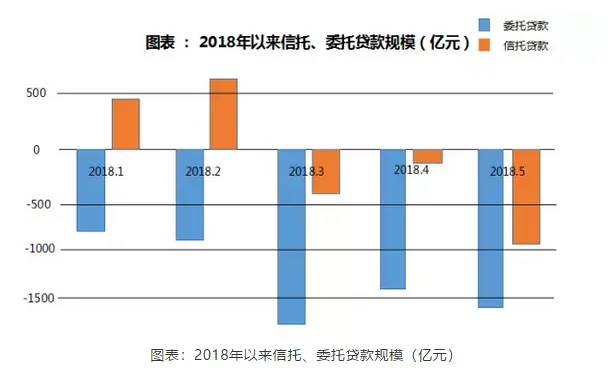
Financing conditions for Chinese property developers have tightened as regulators curb leverage and the property bubble: entrusted loans have fallen for five consecutive months and trust loans dropped sharply in May 2018. A JLL study argues that asset securitisation, long mature in the United States but only beginning in China, could become the main financing route for developers and asset holders, with CMBS, RMBS and ABS releasing asset value while preserving some of its upside. The article sets out the figures and the landmark deals.
1. The difficulty
Traditional financing channels for developers are deadlocking
Since last year the domestic financing environment has been far from encouraging. With financial risk being guarded against, borrowing by highly indebted companies strictly controlled, household leverage prevented from rising too fast and the property bubble further suppressed, financing for developers has become harder and harder.
Entrusted lending has fallen steadily and trust financing has dropped further, so that the non-standard channels are not promising. On the central bank's figures for the first five months, the increase in social financing was 760.8 billion yuan in May, against 1,560.5 billion yuan in April, a fall of 51.25 per cent month on month and 2.84 per cent year on year. Entrusted loans fell by 157 billion yuan in May, 129.2 billion more than a year earlier, and have fallen year on year for five months together; trust loans fell by 90.4 billion yuan in May, 271.6 billion more than a year earlier, the decline widening. And as the Federal Reserve plays down quantitative easing and raises rates, the days of easy financing and refinancing for Chinese developers and asset holders may be gone for good. A new round of tightening by the central government in particular may make financing harder still: "To obtain the funds they need and reduce the cost of financing, developers and asset holders will have to combine traditional routes such as bank loans and corporate bonds with other financing channels."
2. The opportunity
Securitisation may change the shape of real estate finance
JLL has recently published a full and detailed study, Real Estate Finance in China: Tradition and Innovation Together, which surveys every kind of financing Chinese developers use — domestic and foreign bank loans, corporate bonds, senior notes, perpetual bonds, trust companies, P2P, crowdfunding, joint development and more — and dwells on securitisation, setting out the opportunities and the challenges in China for real estate investment trusts (REITs), commercial mortgage-backed securities (CMBS) and other newer vehicles.
Zhou Zhifeng, head of research in China at JLL, said that securitisation, long mature in the United States and elsewhere, has only just begun in China but has great potential. It may become the main financing choice for Chinese developers and asset holders, and may even change the whole shape of real estate finance in China.
At present the forms of securitisation most relevant to Chinese developers are:
commercial mortgage-backed securities (CMBS);
residential mortgage-backed securities (RMBS);
asset-backed securities (ABS).
Their common feature is that they help an asset holder release the value of assets while retaining part of their potential for future growth.
3. The outlook
The potential for securitisation by developers is enormous
Once the People's Bank of China relaxed its control over the sale of these structured products they became gradually popular in the Chinese market from 2015, but the market remains small: beside a mature market such as that of the United States, China's mortgage securitisation market is a drop in the ocean. By the figures, CMBS issued in the United States in 2016 totalled 76 billion US dollars, 98 per cent of the world total, and in recent years annual issuance there has held steady at 50 to 100 billion dollars since the financial crisis.
In the longer term the potential of securitisation in China is enormous. "Given the size of China's real estate market and the need of banks and developers for alternative financing channels, CMBS, RMBS and ABS will become increasingly popular, and issuance over the next few years is bound to rise," Qiu Yisheng judged.
Several recent innovative deals bear the trend out. In December 2016, for instance, an investment affiliate of Gold East Paper (China) Investment Co. Ltd launched the first CMBS product in China, with a total transaction value of 7.8 billion yuan; and in August 2017 Everbright Real Estate Investment Consulting, working with its affiliate Shouyu Guangxing Asset Management Ltd, launched the first ABS product in China, with a total transaction value of 1.6 billion yuan.