
ABS series (4): opportunities in property developers' financing innovation, and where REITs are heading
REITs are a widely used real estate investment vehicle abroad, with 86.1 billion yuan issued in China in 2017 and more than a trillion US dollars of assets worldwide, some ninety per cent of it in equity REITs. Because the mainland has no REITs that fully meet international rules, the market uses securitised quasi-REITs secured on commercial property rents and capital growth, and policy has gradually turned supportive. The article traces that shift and the legal services such transactions require.
Quasi-REITs as a booster for property developers
REITs are a real estate finance vehicle widely used in international capital markets, and 86.1 billion yuan of REITs were issued in 2017. Their scale now exceeds a trillion US dollars, dominated by equity REITs at about 90 per cent, with mortgage REITs at about 10 per cent. In detail, the types of quasi-REIT product in the domestic market in 2017 were as follows.
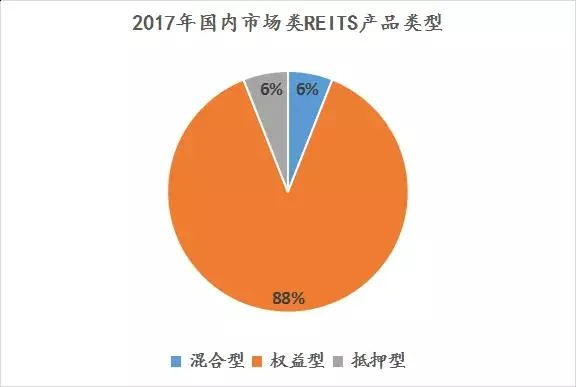
(Source: CNABS REITs industry research)
For reasons of regulation and of the capital market, the Chinese mainland as yet has no REITs that fully comply with international rules; instead they take the form of securitised "quasi-REITs". Quasi-REITs are at present aimed mainly at commercial property, issuing ABS secured on the rents of that property and on its capital appreciation. Commercial property in China has grown explosively in recent years and the market is saturated, so that it has entered an era of stock; more and more developers are making commercial property a key direction of transformation and adopting the slogan of making assets lighter. At the same time the fees for malls, public facilities, apartments and office buildings are a good source of funds for developers, and quasi-REITs therefore offer them a sound approach to development.
TIP:
REITs stands for Real Estate Investment Trusts. It is a vehicle that pools funds from many investors by issuing beneficiary certificates, is managed by a specialised institution, and builds a portfolio by investing in different types of real estate project in different regions; while effectively reducing risk, it distributes the income from letting the property to shareholders by way of dividends, so that investors may seek stable long-term returns.
National policy sends favourable signals
In fact the first move came in 2005, when the China Banking Regulatory Commission issued the Notice on Risk Warnings concerning the Real Estate Trust Business of Trust Companies, which imposed strict requirements on the threshold for issuing real estate trusts and warned trust companies of the risks of that business, requiring each of them to carry out at once a self-check of the compliance and risk of its business, analysing transaction by transaction, including but not limited to:
whether the real estate project financed by the trust company's loan satisfies the requirement that all four certificates be complete, whether the developer or its controlling shareholder holds second-class qualification, and whether the proportion of project capital reaches the national minimum;
an assessment of the sufficiency and reliability of the first source of repayment;
the position and assessment of mortgages, pledges and other security;
an assessment of the project's ability to repay at maturity, and the contingency plan for risk.
Not long afterwards, the departments concerned issued documents supporting the development of REITs. In 2008 the People's Bank of China published its report on the development of China's financial market in 2007, making clear that the innovative space in the financial market should be fully used and that REITs products might be launched at an opportune time in the period ahead.
There is now a tendency for documents to support quasi-REITs. The General Office of the State Council published the Several Opinions on Speeding Up the Cultivation and Development of the Housing Rental Market, in force from 3 June 2016, Article 14 of which provides: "Financial institutions are encouraged, in accordance with law and regulation and on the principles of controllable risk and commercial sustainability, to provide financial support to housing rental enterprises. Qualified housing rental enterprises are supported in issuing bonds and real estate securitisation products. The pilot scheme for real estate investment trusts (REITs) shall be steadily advanced."
Conclusion
Because their income is stable, REITs will go on developing over the coming years. In 2017 China's REITs saw many breakthroughs and the first innovative products appeared, and in 2018 the real estate industry is undergoing a new round of reshuffling to embrace them. Minton will continue to follow the legislation and the trends in asset securitisation and to provide professional legal services throughout a project:
working with other intermediaries to analyse whether the underlying assets may be securitised;
designing a securitisation structure and scheme that meets the needs of all parties to the transaction, and providing legal argument on risk prevention;
carrying out legal due diligence on the parties concerned and the corresponding underlying assets, analysing and determining the legal character of the underlying assets and the lawfulness and effectiveness of the security for them by reviewing the corresponding contracts and other legal documents, and issuing a due diligence report;
working with other intermediaries to set the criteria for assets to be pooled, and, in accordance with the agreed transaction structure, drafting and revising the transaction documents and issuing legal opinions.