
ABS series (1): the detailed process and rules for corporate asset securitisation
Asset-backed securitisation takes assets that will produce future cash flow, structures and enhances them, and issues securities against them, turning an expected future return into money now. China has four models, of which the CSRC-regulated special plan for non-financial enterprises is the subject of this article. It follows the process from choosing the underlying assets, through the bankruptcy-remote special purpose vehicle, to issue and sale, management and final settlement, and closes with the benefits claimed for issuers and for investors.
1. The concept of asset securitisation
Asset securitisation, or ABS, is the process of issuing asset-backed securities on the security of the cash flow that underlying assets will generate in future, with credit enhancement achieved through a structured design.
In essence it packages the cash flow from the underlying assets into securities that are easy to sell, turning an expected future cash flow into money at once.
China has four forms of asset securitisation:
1. securitisation of the credit assets of financial institutions, supervised by the central bank and the banking regulator;
2. securitisation of the special assets of non-financial enterprises, supervised by the CSRC;
3. asset-backed notes (ABN) of non-financial enterprises, supervised by the dealers association;
4. asset-backed plans of insurance asset management companies, supervised by the insurance regulator.
The four differ mainly in the originator, the underlying assets, the transaction structure and the place of listing and trading.
This article gives a brief account of securitisation by non-financial enterprises under the supervision of the CSRC.
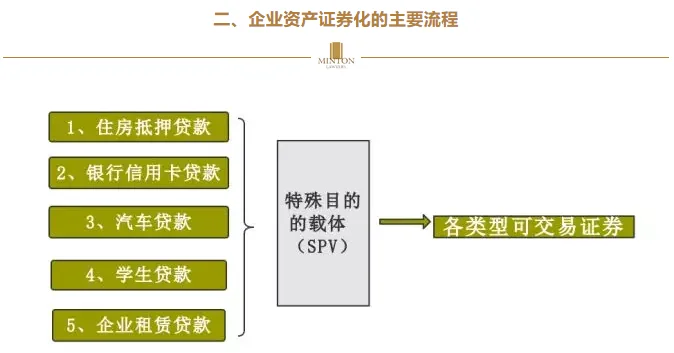
Step 1: selecting the underlying assets
The originator of a securitisation chooses assets that will generate stable cash flow in future, strips them out and consolidates them into the asset pool for the product to be issued.
Assets that may be used to issue such a product are those that generate continuous and stable cash flow, such as receivables, rent income, operating fees, trust income and financial claims.
Note: particular assets placed on the negative list by the Asset Management Association of China may not be securitised.
Step 2: the special purpose vehicle (SPV)
The originator transfers or sells the underlying claim assets to a special purpose vehicle (SPV). The SPV is an institution independent of the originator and central to the securitisation: in theory an independent intermediary structure with the effect of bankruptcy remoteness, and the issuer of the securities.
Under the Provisions on the Administration of Securitisation Business of Securities Companies and Subsidiaries of Fund Management Companies, a special purpose vehicle is an asset-backed special plan set up specifically by a securities company or by a subsidiary of a fund management company for securitisation business, or another special purpose vehicle recognised by the CSRC.
Under those provisions, when an enterprise issues a securitisation product the SPV may be an asset-backed special plan established by a securities company or by a fund company's subsidiary.
Step 3: issuing and selling the securitisation product
With the help of law firms, accounting firms, credit rating agencies and credit reference agencies, the SPV files with the competent authority, issues the asset-backed securities and raises funds from securities investors. Such a product may generally be offered publicly or placed privately, and once the sale is complete the SPV pays the proceeds to the originator at the price agreed.
Step 4: managing the product and settling at maturity
Once the securitisation has succeeded the SPV engages professional institutions to manage the asset pool, the main work being to collect the cash flow from the pool, to transfer cash between accounts and to deal with the related tax and administrative matters. On the settlement date the SPV repays the holders in instalments and pays their return as agreed, and any cash flow remaining after all payments are made is returned to the originator.
In practice, to ensure that investors receive principal and interest on time, a securitisation transaction usually has a dedicated asset servicing institution responsible for collecting principal and interest from the debtors, and the commonest arrangement worldwide is for the original holder of the claim assets to take on that role.
Note: in a corporate securitisation, credit guarantee and credit enhancement institutions may provide credit enhancement for the product and credit rating agencies supply rating results, which are not described in detail here.
3. What securitisation does for an enterprise
For the enterprise
1) it is a new financing channel besides bank borrowing, equity financing and listing;
2) it recovers future returns in advance, shortens the time needed to get the money back, improves the turnover of funds and increases cash flow;
3) the product is rated on the securitised assets themselves rather than on the company;
4) the procedure is relatively convenient.
For investors, that is the holders of the securities
1) the investment risk is smaller than in shares or futures;
2) the return is relatively stable;
3) it is a new investment product.
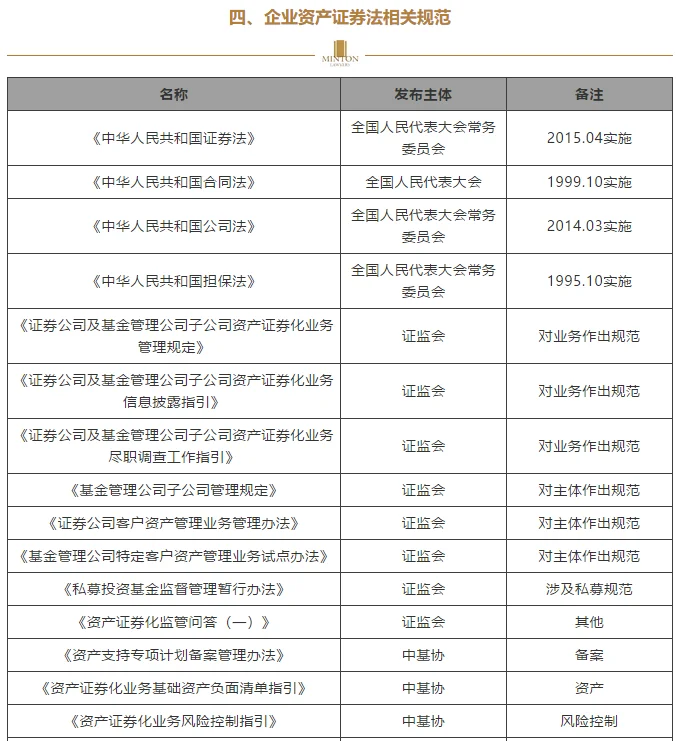
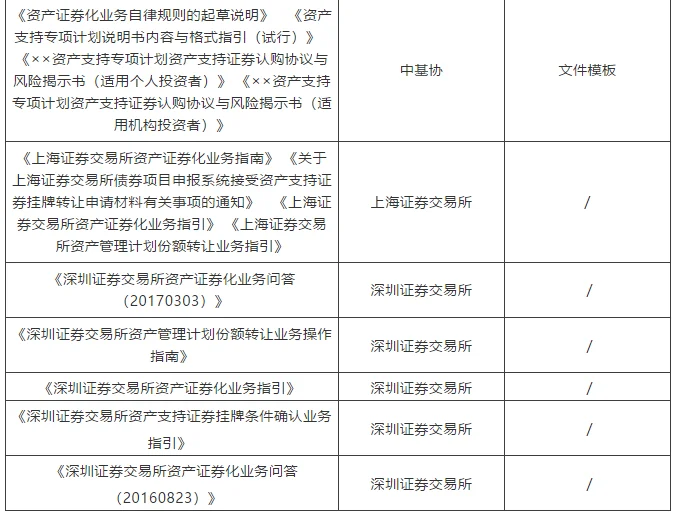
An enterprise that securitises assets through the proper procedure can bring funds back effectively, increase the liquidity of its capital and strengthen its capacity for continued operation, and securitisation is a new way of raising finance. For investors, the relatively stable return and relatively low risk of corporate securitisation products make them a sound investment channel as well.