
What is new in the individual income tax rules: the special additional deductions
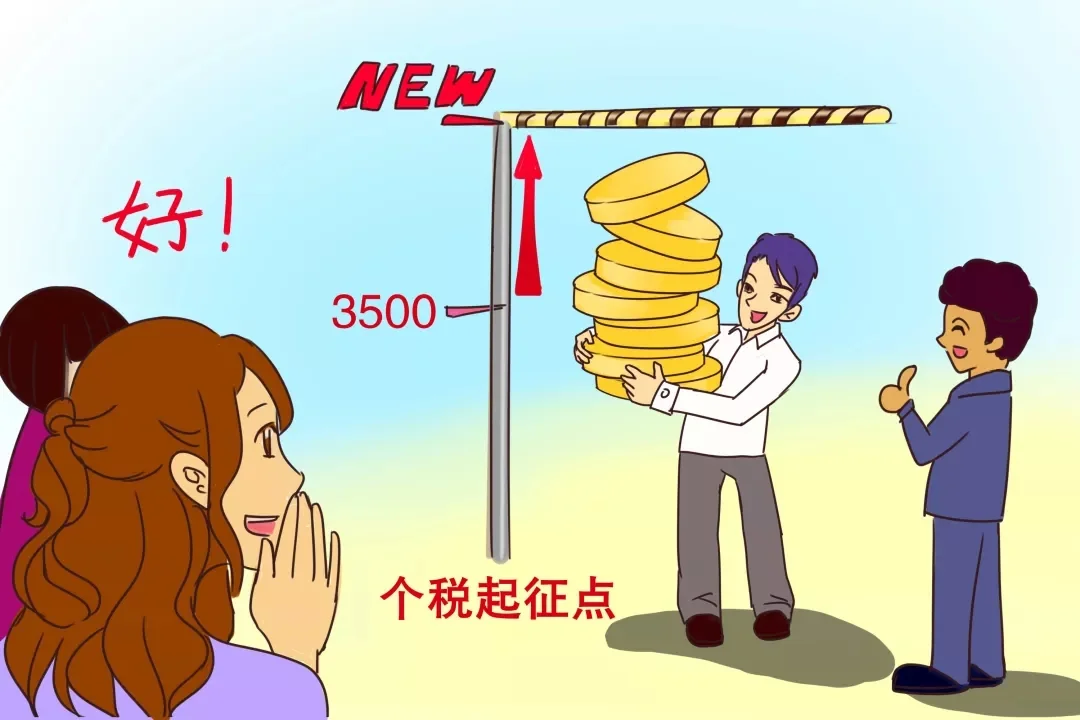
From 1 October 2018 the threshold for individual income tax in China rose from 3,500 yuan to 5,000 yuan a month, and from 1 January 2019 six special additional deductions took effect, for children's education, continuing education, support of elderly parents, serious illness, housing loan interest and housing rent. The article explains each deduction in turn and works through an example in which a taxpayer's monthly tax falls from 3,120 yuan to 830 yuan, a reduction of 73 per cent.
From 1 October 2018 part of the tax-cutting measures in China's amended Individual Income Tax Law entered the implementation stage, raising the threshold from 3,500 yuan to 5,000 yuan. On 20 October the Interim Measures for the Special Additional Deductions of Individual Income Tax (draft for comment), the interim measures, were published, adding new special additional deductions
which took effect on 1 January 2019 and prompted a fresh round of discussion about tax cuts.
The reform changed the scheduler system of taxation that had been in use in the 38 years since the individual income tax was introduced in China, and marks an important turning point on the way to comprehensive assessment. The key to the reform is not the rise in the threshold from 3,500 to 5,000 yuan but the inclusion, within a mixed system, of a "small comprehensive" element and of "multiple deductions", which lightens the individual's overall tax burden while
applying the principle of fairness more effectively.
In theory the point of deductions is to remove from the tax base the living costs a person incurs in discharging different social responsibilities, and at the same time to balance regional differences, so that tax plays its regulating role properly. The new law provides six deductions, for children's education, continuing education, support of
elderly parents, serious illness, housing loan interest and housing rent, and each of the special deductions has its own specific requirements.
1. Children's education
Expenditure by a taxpayer on pre-school education and academic education for his children is deducted at a flat rate of 12,000 yuan a year, or 1,000 yuan a month, for each child. Pre-school education runs from the age of three until entry to primary school; academic education covers primary school through doctoral study.
The deduction for children's education is claimed by the child's parents or other legal guardian. The parents may each claim 50 per cent of the standard, or one of them may claim 100 per cent.
2. Continuing education
Expenditure by a taxpayer on continuing academic education is deducted at a flat rate of 4,800 yuan a year, or 400 yuan a month, for the period of that education; expenditure on continuing education for a vocational qualification as a skilled worker, or as a professional and technical worker, is deducted at a flat rate of 3,600 yuan for the year in which the relevant certificate is obtained.
Continuing academic education may be claimed by the taxpayer himself as expenditure on continuing education, or by his parents as expenditure on their children's education.
3. Support of elderly parents
Expenditure by a taxpayer on supporting parents aged 60 or over, and other persons whom he is legally bound to support, is deducted at a flat rate on the following basis.
A taxpayer who is an only child deducts 24,000 yuan a year, or 2,000 yuan a month. A taxpayer who is not an only child shares the annual deduction of 24,000 yuan with his brothers and sisters.
4. Serious illness
Medical expenditure borne by the taxpayer himself in a tax year which, as recorded in the social medical insurance management information system, exceeds 15,000 yuan is treated as serious illness expenditure and may be deducted in the amount actually incurred, up to a limit of 60,000 yuan a year.
The deduction is claimed by the taxpayer himself, on the original (or a copy) of the medical service invoices.
5. Housing loan interest
Interest on a first home loan taken out by the taxpayer or his spouse with a commercial bank or the housing provident fund to buy a home for himself or for his spouse may, while the loan is being repaid, be deducted at a flat rate of 12,000 yuan a year, or 1,000 yuan a month. Interest on a loan for a home that is not the first may not be deducted.
By agreement between husband and wife, either of them may claim the deduction, and the method chosen may not be changed within a tax year.
6. Housing rent
Where neither the taxpayer nor his spouse owns housing in the city where the taxpayer mainly works, rent paid for housing in that city may be deducted at a flat rate on the following basis.
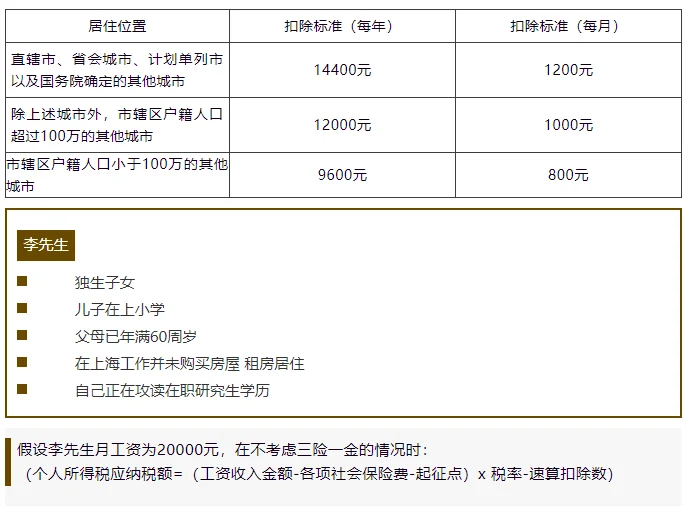
Case one:
Before 1 October 2018 — the threshold of 3,500 yuan applies, with the former rates
Mr Li's monthly tax = (20,000 − 3,500) x 25% − 1,005 = 3,120 yuan
Case two:
After 1 October 2018 — the threshold rises to 5,000 yuan and the new rates apply
Mr Li's monthly tax = (20,000 − 5,000) x 20% − 1,410 = 1,590 yuan
That is 1,530 yuan less than before the new rules came in, a fall in the tax burden of nearly 50 per cent.
Case three:
From 1 January 2019 — Mr Li may claim four special additional deductions, for children's education, continuing education, housing rent and support of elderly parents, of 1,000, 400, 1,200 and 2,000 yuan respectively, 4,600 yuan in all.
Mr Li's monthly tax = (20,000 − 5,000 − 4,600) x 10% − 210 = 830 yuan
Compared with the position before the reform, the reduction in tax is 73 per cent.
The things that most worry China's post-80s and post-90s generations today are medical care, housing, education and old age, and the core of this reform lies in lightening the burden on ordinary families and improving their quality of life, so releasing the benefits of reform.
Although the special additional deductions took effect only on 1 January 2019, many people are already worrying about how the policy will work in practice: what to do about false declarations, what to do where husband and wife both claim a deduction, why expenditure on children's education does not vary with region, and a series of other questions. But as Marx said,
there are no rights without duties, and no duties without rights. The reform gives taxpayers a real benefit and at the same time places new responsibilities on them, such as the originals or copies of invoices required by the new rules.
Making the special additional deductions work requires honesty and cooperation from individuals, and still more the cooperation of employers, the government and every department of society. Especially since the reform touches housing, medical care, education and old age, only by straightening out relations between departments and strengthening coordination can the reform of the special additional deductions for individual income
tax be brought to complete fruition.