
The divorce cooling-off period
Where spouses apply to a registration office to divorce by consent, the Civil Code imposes a cooling-off period of 30 days from the date the application is received, during which either of them may withdraw it. If neither withdraws, the parties must appear in person within the following 30 days to collect the certificate; if they do not, the application is treated as withdrawn. The period applies only to divorce by agreement, not to litigation, so a spouse who has suffered domestic violence may still go to court.
The cooling-off period is the interval, running from the date the marriage registration office receives an application for divorce by consent, within which either party may withdraw that application.
The effect of the period is to establish whether the wish to divorce is genuine. If, after thinking it over, the parties do wish to divorce, the registration continues, the certificate is issued and the marriage ends. If either of them does not, he or she may apply to the office to withdraw, the registration procedure ends and the marriage continues.
The text of the provisions
Article 1077 Within 30 days from the date the marriage registration office receives an application to register a divorce, either party who does not wish to divorce may withdraw the application with that office.
Within 30 days after the period in the preceding paragraph expires, the two parties shall appear in person at the marriage registration office to apply for the issue of a divorce certificate; if they do not apply, the application is treated as withdrawn.
The procedure is set out in the chart:
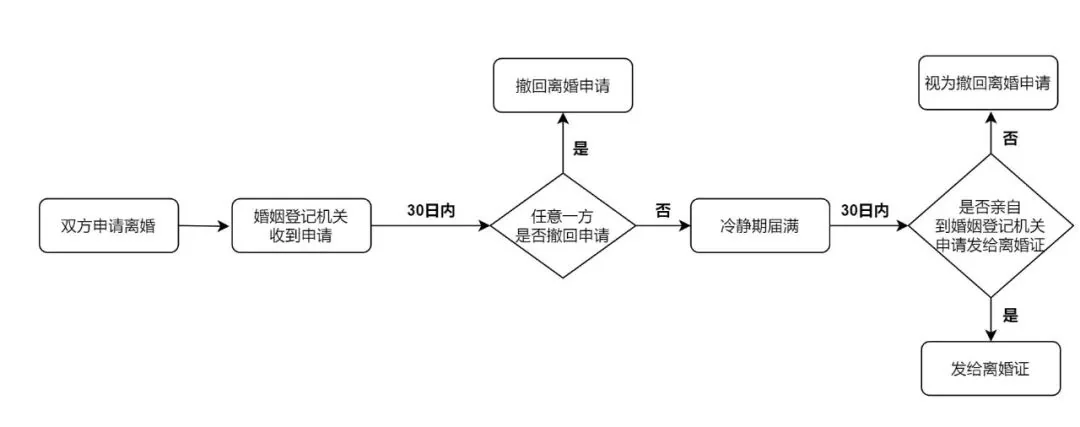
1. The parties, both willing to divorce, apply to the marriage registration office. If the conditions for divorce are met, no certificate is issued at once.
2. The cooling-off period is 30 days. Within 30 days from the date the office receives the application, either party who does not wish to divorce may apply to withdraw it.
3. Within 30 days after the period expires, the parties, if they still wish to divorce, shall appear in person at the office to apply for the certificate.
4. If within those 30 days they do not apply to the office, the application is treated as withdrawn.
02
When the period applies
Does the cooling-off period created by the Civil Code mean that a spouse who has suffered domestic violence is also bound by it?
The answer is no.
The period applies only where the parties divorce by agreement, not where a divorce is litigated.
Where there are statutory grounds for divorce such as domestic violence, abandonment of family members or bigamy, or where the parties cannot agree on the terms of a divorce by consent, they may go straight to court.
The cooling-off period therefore changes only the procedure for divorce by agreement. It does not affect proceedings in court, and it does not mean that a divorce is impossible where one party objects: if agreement cannot be reached and the relationship has in fact broken down, a divorce may still be obtained by litigation.
The cooling-off period rests on respect for freedom to divorce. The law does not restrict that freedom; it respects the wishes of the parties and, where both want a divorce, allows them time to think it over, so that they do not divorce rashly in a moment of impulse.
Related service: Family