
Training providers are collapsing: how to avoid the traps
After years of breakneck growth, the social training sector is showing the after-effects of expansion that management could not keep up with. This year several well-known offline providers, among them Yousheng Education, Jushi Dazhen and Fanqietian, and the online provider Dada English, have closed branches or disappeared, leaving parents unable to obtain refunds. Rules issued since 2018 cap prepayment: no single charge may cover more than three months, and an online provider charging by lesson may not collect more than 60 lessons at a time. Parents should check reputation, ensure the contracting party matches the payee, and watch for rent or staffing problems.
The social training industry went through years of breakneck, unregulated growth, and the after-effects are now showing: headlong expansion was not matched by management in time. Since the start of this year many training institutions have been reported as closing or absconding, among them well-known offline education and training providers such as Yousheng Education, Jushi Dazhen and Fanqietian, and the online provider Dada English. After the experience of the COVID-19 pandemic, many institutions are suffering from old complaints that have not healed and new wounds besides, and the disorder in the sector has been remarkable.
Yousheng Education, in particular, was reported to have closed outlets in Xi'an, Beijing, Shanghai, Tianjin, Chengdu, Chongqing, Harbin and elsewhere, leaving parents in the awkward position of having nowhere to go for refunds.
Children are the flowers of the nation today and its pillars tomorrow, and parents spend a great deal on their education, of which tutoring outside school is an important part. Choosing a reliable provider in a market so full of disorder, and avoiding the consumer traps that the parents seeking redress from the providers mentioned above have met, calls for caution upon caution.
In fact, looking back at the rules made by the state from the centre down to the localities in recent years, whether the Opinions on Regulating the Development of Out-of-School Training Institutions published by the General Office of the State Council in August 2018, or the local rules such as the Standards for Running Private Education and Training Institutions in Beijing (interim), the Measures of Shanghai Municipality for the Supervision and Administration of Training Institutions, the Measures of Guangdong Province for the Supervision and Administration of For-Profit Private Training Institutions and the Rules of Jiangsu Province on Conduct in Training Charges, all provide in detail for the fees that training institutions may charge, and any of them can be the basis on which parents seek redress for unreasonable charges.
The writer offers parents a few suggestions below, to help them avoid some of the traps common in the training industry.
1. Before choosing a provider, find out its reputation in the sector, and choose one with a good record.
There are usually plenty of providers around schools and in large shopping districts catering for every purpose a child may have. Before choosing, parents can investigate a provider's reputation through introductions from friends, enquiries among classmates and other channels, paying particular attention to providers, or their predecessors, that have attracted negative coverage, so as to avoid the situation where the founders and core staff of a provider in difficulties simply set up another institution, change its coat and carry on deceiving parents and children.
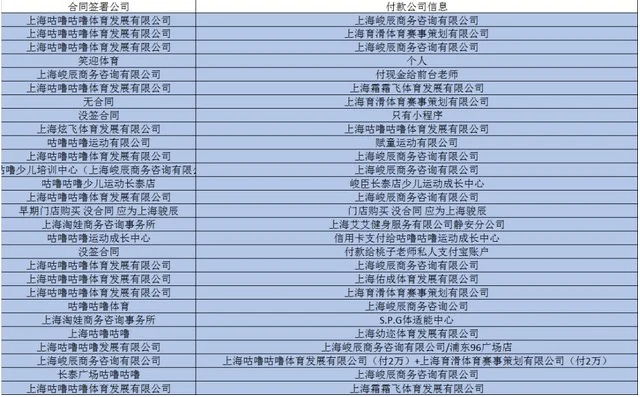
2. Take care when signing a training services contract, and check that the contracting party matches the account to which payment is made.
Normally, the company with which a parent signs the services contract should be the company to which the training fees are paid, but the services contracts of Gulu Gulu, a children's sports training provider that ran into trouble this year, were in a complete muddle. According to information some parents provided, the companies that signed contracts with them and the companies that received payment were as shown in the figure below:
3. When paying, do not pay for a long period merely because of a large discount
The Opinions on Regulating the Development of Out-of-School Training Institutions issued by the General Office of the State Council in 2018 expressly require that fees "must not be collected in a single payment covering a period longer than 3 months". The Implementation Opinions on Regulating Online Training Outside Schools, issued jointly in July 2019 by the Ministry of Education and five other departments, also require that an online training institution charging by lesson may not collect, for each subject, payment for more than 60 lessons at one time, and that an institution charging by training cycle may not collect fees in a single payment covering a period longer than 3 months.
Having chosen a provider, parents must stay level-headed and not be tempted by so-called large discounts or other concessions; they should agree a reasonable payment cycle or number of lessons with the provider, so as to avoid the situation where the institution absconds while the child is still studying, or where lessons remain unused after the child has finished.
4. Find out whether the provider is involved in disputes over rent or property management
There are usually signs before a training institution closes or absconds: whether it is already behind with the landlord's rent, or with the property company's management fees and utility charges, and whether teachers have been leaving in large numbers within a short period. Where parents see signs of this kind, they should avoid choosing that provider, or should not renew its training contract.
Of course, if parents are currently facing a provider that has absconded and difficulty in recovering their hard-earned money, they are advised to consult a professional or a practising lawyer as soon as possible, to take that person's professional view and to use the law to assert their rights.
Minton lawyers' hotline for advice on claims against training institutions:
021-68819098