
What is a void marriage
A marriage certificate issued by the civil affairs bureau does not by itself make a marriage valid. Under the Civil Code a marriage is void on three grounds: bigamy, a prohibited degree of kinship, or a party below the statutory age of marriage, which is 22 for men and 20 for women. Either spouse or an interested person may ask a people's court to declare the marriage void, and the range of interested persons depends on the ground relied on. Such a claim cannot be withdrawn, and the court may declare the marriage void of its own motion.
01
Void marriages
Does registration at the civil affairs bureau and the issue of a marriage certificate necessarily make a marriage lawful and valid?
The answer is no.
The Marriage and Family Part of the Civil Code provides for void marriages.
A void marriage, also called a marriage of no effect, is a union that lacks the substantive or formal requirements for a valid marriage, has no legal effect as a marriage, and ought to be declared void.
Two conditions must be satisfied before an application can be made: 1. a statutory ground; 2. the applicant must be a party to the marriage or an interested person.
02
Statutory grounds
01 Bigamy
The unlawful conduct of a person who has a spouse registering a marriage with another person, or of a person who, knowing that the other has a spouse, registers a marriage with that other.
02 A prohibited degree of kinship
This covers lineal consanguinity and collateral consanguinity within three generations. To protect the health of later generations and order within the family, the law treats such a marriage as void.
03 Below the statutory age of marriage
The statutory age of marriage is 22 for men and 20 for women. A marriage registration office will not register a marriage where a party is below that age. A registration that has already been obtained is a void marriage.
03
Who may apply
Apart from the parties to the marriage, other interested persons may also apply to have a marriage declared void. The range of interested persons differs according to the ground relied on.
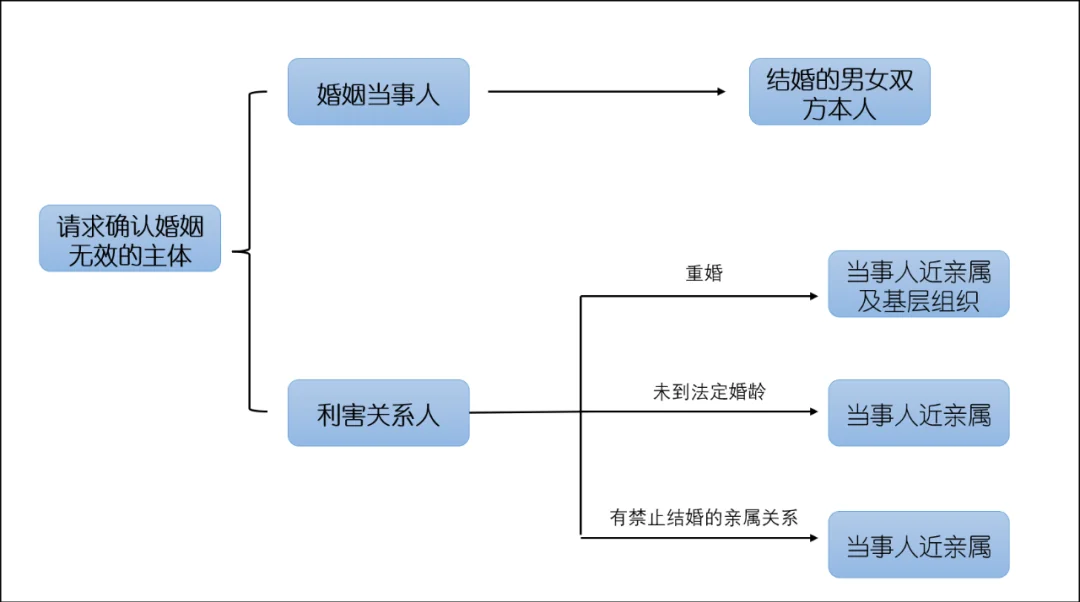
Where bigamy is relied on, the interested persons are the close relatives of the parties and the grassroots organisations; where the ground is that a party was below the statutory age or that the parties are within a prohibited degree of kinship, the interested persons are the close relatives of the parties.
So in particular circumstances a marriage may be void even though a certificate was obtained from the civil affairs bureau. Where a statutory ground is satisfied, the parties may apply to have the marriage declared void.
Because of the harm such marriages do to society, a claim to have a marriage declared void cannot be withdrawn. In addition, if in the course of hearing a case the people's court finds that the marriage before it is void, it has the power under the law to
make a judgment declaring the marriage void.
The text of the provisions
Civil Code of the People's Republic of China
Article 1051 A marriage is void in any of the following circumstances:
(1) bigamy;
(2) the parties are within a prohibited degree of kinship;
(3) a party is below the statutory age of marriage.
Interpretation (I) of the Supreme People's Court on the Application of the Marriage and Family Part of the Civil Code of the People's Republic of China
Article 9 The persons entitled under Article 1051 of the Civil Code to apply to a people's court for confirmation that a registered marriage is void are the parties to the marriage and interested persons. Interested persons are:
(1) where bigamy is relied on, the close relatives of the parties and the grassroots organisations;
(2) where a party was below the statutory age of marriage, the close relatives of that party;
(3) where the parties are within a prohibited degree of kinship, the close relatives of the parties.