
Juvenile crime: tolerance cannot be the only answer
In December 2018 a twelve-year-old boy in Yuanjiang, Hunan, killed his mother with a knife after she beat him for smoking, and was released because he was below the age of criminal responsibility; his relatives' attempt to send him back to school met fierce opposition from other parents. The article sets out the age thresholds in the Criminal Law, the rising figures for juvenile offending, the argument for lowering the age, and the correction and education that should follow instead of simple release.
1. The incident
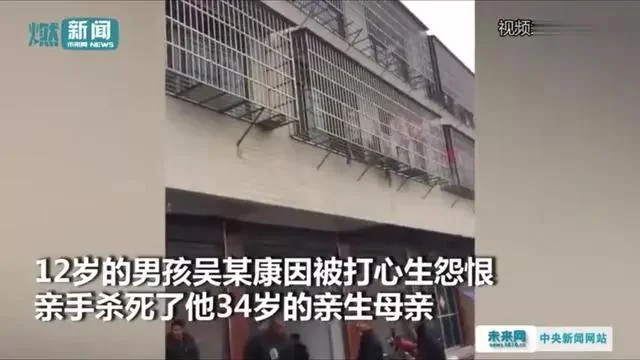
Last week the news that a twelve-year-old boy, Wu, had killed his mother with a knife in Yuanjiang, Hunan, caused a sensation. On preliminary questioning, Wu had been beaten with a belt by his mother after she caught him smoking at home; resentful of her strict discipline, he attacked her with a knife at about nine o'clock on the evening of 2 December, striking her more than twenty times and killing her on the spot.
Once the facts were established Wu behaved as though nothing had happened, and even said: "I didn't kill anyone else, I killed my mother." "The school can't refuse to let me go back, can it?" Such remarks left people astonished.
Just as people were discussing how severely this unfilial son should be punished, on 12 December Wu was released by the local police for not having reached the age of criminal responsibility. The local education department explained that Wu, being under fourteen, could not be detained or sent to a juvenile correction facility, and had therefore been released into his family's custody. Wu's relatives wanted to send him
back to school to continue his education, but met strong opposition from other parents and a considerable public backlash. The case has once again focused attention on juvenile crime and prompted fierce argument about whether the age of criminal responsibility should be lowered.
2. Juvenile crime is frequent
Punishment is the severest of legal sanctions, but the criminal law is by nature restrained and its conditions of application are relatively strict. Minors are the flowers of the nation, its hope and its future, and being young and immature they are given special protection by the law. Under the Criminal Law of the People's Republic of China, a person who has reached
sixteen bears criminal responsibility for any crime, while a person of fourteen or over but under sixteen bears it only for eight serious crimes. Within the Chinese legal framework, then, a person under fourteen bears no criminal responsibility at all. Under the principle of legality, the boy who killed his mother, Wu, bore
no criminal responsibility whatever, and his release was indeed in accordance with the law. Lawful as it was, the ease with which Wu regained his freedom alarmed the people around him, particularly since, having killed his mother, he said as though nothing had happened: "I didn't kill anyone else, I killed my mother." To return in that state of unthinking fearlessness
to school and to society is enough to make anyone's blood run cold.
The purpose of the legislation was to protect minors who act on impulse from being unable ever to return to society, and to give them a chance to reform. In recent years, however, this rule has faced growing challenge and doubt. According to a survey by the Legal Daily, compared with the beginning of the twenty-first century the crime rate among young people under fourteen has risen
by about 280 per cent. The white paper on the comprehensive trial of juvenile cases published by the Beijing No. 1 Intermediate People's Court in 2016 shows that of the juvenile crime cases it heard, 85.04 per cent involved offenders of sixteen or over but under eighteen, and 14.96 per cent offenders of fourteen or over but under sixteen, and that the crimes
were cruel in method and grave in consequence.
In recent years cases of serious crime by minors, and especially by young minors, have forced their way into public view again and again and jolted the public mind again and again: from the intentional killing resolved by a "handshake and reconciliation" to the rape case in which the parties "buried the hatchet", and on to the frequent outbreaks of serious violence in schools. They test the public's capacity
to bear such things, and the label "minor" seems to have become a charm allowing them to violate others and trample on the law at will. Against that background, many have called for the age of criminal responsibility to be lowered.

3. The argument over lowering the age
Faced with what looks like a surge of violence by young minors, many argue that the present age of criminal responsibility should be reduced, so as to widen the reach of punishment and strengthen deterrence. As long ago as 2016 a deputy to the National People's Congress proposed lowering the age so that violent young offenders could be dealt with under the criminal law. With economic and social development
and rising living and educational standards, minors mature physically and psychologically and their cognitive capacity has improved to a degree that cannot be compared with the period in which the law was made; there is indeed reason to move the age of criminal responsibility up somewhat, and so to reshape the legal conduct of minors.
At the same time it is worth noting that the General Provisions of the Civil Law of the People's Republic of China, in force from 1 October 2017, lowered the age at which a person has limited capacity for civil conduct from ten to eight. Criminal and civil capacity cannot of course be conflated, but both
involve judgment and weighing of the level of understanding and, on that basis, of the capacity to recognise and control conduct and to bear legal responsibility; and in some respects the understanding required in criminal law may be lower than that required in civil law, as with the prohibition on taking another person's life. It follows
that in setting the age of criminal responsibility, following the movement of the civil law and making an appropriate fine adjustment, so as to keep the legal system unified and complete, should be a practical step.
Changing the age of criminal responsibility is, of course, an extremely serious legislative task. It must not be swayed by the online opinion and public emotion stirred up by an extreme individual case, nor driven by an intuition of justice and a plain morality that come from nowhere; a final conclusion can be reached only
on the basis of a large body of objective statistics, surveys, research and argument.

4. Thinking about juvenile crime
Wu's exemption from criminal responsibility does not mean that he escapes all legal consequences. Article 17, paragraph 4, of the Criminal Law provides that his parents and guardian shall discipline him and that, where necessary, the government may take him into custody for education. "Custody for education", which exists to maintain social order and the safety of most
members of society by educating and rescuing minors who bear no criminal responsibility, does in practice prevent juvenile crime. From the point of view of protecting minors, prevention matters far more than punishment. In this case, however, Wu not only suffered
no substantive punitive measure but was not even subject to control, correction or a similar preventive measure, which accords neither with the purpose of the Law on the Protection of Minors nor with the public's ordinary sense of what is right. It was because of the danger he presents and the possibility that he will offend again that the parents opposed so strongly
the return of the boy who killed his mother to school.
The lowering of the age at which crime is committed is not only a legal question but a social one, produced by family guardianship, schooling, social governance and other factors together. In dealing with juvenile crime, neither tolerance nor severe punishment should be the only emphasis: bringing minors who have done harm back into society is the best protection society can have. That requires not only stronger family guardianship and school
responsibility, but effective control and correction by law enforcement and judicial departments of minors who have already offended, and, where necessary, custody for education, so that they abandon their bad habits and cease to endanger society, and society can receive them with peace of mind.