
Can employers in Shanghai set sick pay at their own discretion?
Shanghai's 1995 notice on sick pay for enterprise employees lapsed on 15 August 2026, and employers have been asking on what basis sick pay should now be paid. The fallback is the 1995 Ministry of Labor opinion, which requires sick pay during the medical treatment period to be no less than 80 per cent of the local minimum wage. Where internal rules still reproduce the old notice, its formula continues to apply in substance; where they do not, employers must now set the rate themselves. Shanghai's rules on medical treatment periods are unchanged.
The Notice of the Shanghai Labor Bureau on Strengthening the Management of Sick Leave for Enterprise Employees and Safeguarding Their Livelihood during Sick Leave (Hu Lao Bao Fa [1995] No. 83, 29 September 1995) lapsed on 15 August 2026. Many employers have asked how sick pay should now be paid, and on what legal basis. In my view, where a local normative document lapses, the superior law applies: Article 59 of the Opinions of the Ministry of Labor on Several Issues Concerning the Implementation of the Labor Law of the People's Republic of China (Lao Bu Fa [1995] No. 309) provides that, during the prescribed medical treatment period for illness or a non-work-related injury, the enterprise shall pay sick pay or a sickness relief payment in accordance with the relevant provisions, and that sick pay or the sickness relief payment may be lower than the local minimum wage but not lower than 80 per cent of it. Does that mean employers may now decide sick pay at their own discretion?
I. The former method of calculating sick pay (under Hu Lao Bao Fa [1995] No. 83)
Formula: wage base × coefficient / 21.75 × number of sick days
Coefficient: continuous length of service means the employee's continuous service with the current enterprise, not total years of work. The corresponding percentage is applied, as shown in the table below.
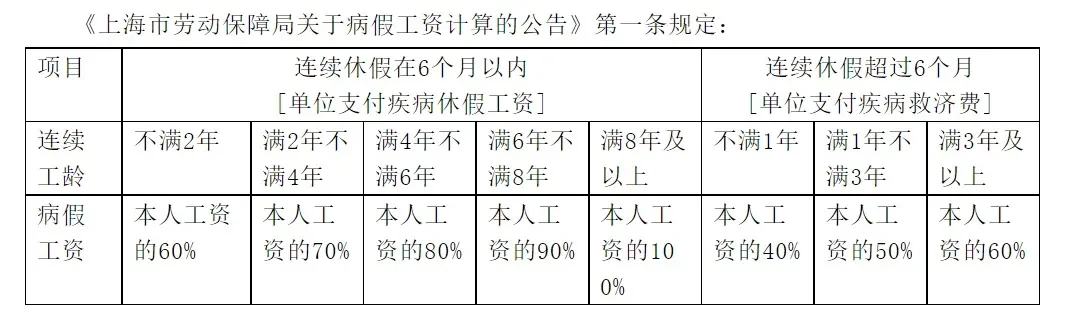
Base: the monthly wage corresponding to normal attendance in the employee's post, excluding year-end bonuses, commuting subsidies, meal subsidies, housing subsidies, night-shift allowances, summer high-temperature allowances, overtime pay and other wages paid in special circumstances (see the Measures of Shanghai Municipality on Wage Payment in Enterprises).
II. How to determine sick pay after the lapse
Under Article 59 of Lao Bu Fa [1995] No. 309, sick pay during the medical treatment period is paid by the enterprise in accordance with the relevant provisions, provided it is not lower than 80 per cent of the minimum wage. Those "relevant provisions" generally mean the provisions in force. Where the local provisions have lapsed and no others apply, the enterprise is given discretion. Accordingly, if the enterprise's internal rules quote or adopt the content of Hu Lao Bao Fa [1995] No. 83, the enterprise must in substance still follow that document; if the rules do not contain that content and merely say that "local provisions shall be followed", the enterprise must now specify how sick pay is to be paid; if the rules provide for paid sick leave as a welfare benefit, that benefit falls within the enterprise's discretion and is unaffected; and if the city issues new provisions in future, those will apply.
Note also that Article 59 is framed as applying "during the medical treatment period". It does not regulate sick pay outside that period, and my research shows four approaches in judicial practice: no payment absent a legal basis, as in (2020) Su 0191 Min Chu No. 2830; no less than 80 per cent of the minimum wage, as in (2023) Jing 01 Min Zhong No. 2902; application of the local provisions, as in (2021) Lu 0211 Min Chu No. 7453; and application of the internal rules, as in (2018) Hu 01 Min Zhong No. 10818.
III. Shanghai's rules on medical treatment periods are unchanged
Under the provisions of the Shanghai Municipal People's Government and the municipal human resources and social security bureau, Shanghai applies a local standard for the medical treatment period, calculated by the employee's length of service with the current employer: three months in the first year, one additional month for each completed year thereafter, up to a maximum of 24 months. The Provisions on the Standards for Medical Treatment Periods for Employees Who Fall Ill or Are Injured Outside Work in the Course of Performing Employment Contracts in this Municipality (Hu Fu Fa [2015] No. 40) have had their validity extended to 30 June 2030, so the rules on medical treatment periods in Shanghai are unchanged.
IV. Cases on sick pay during the medical treatment period
1. Fives XX Company v. Mr Zhou, labor dispute, (2020) Su 0585 Min Chu No. 942. Mr Zhou claimed sick pay of RMB 3,769.7 for January 2019 and RMB 2,815.2 for February 2019. The court held that the employment contract had been terminated on 8 January 2019, so the company was liable for sick pay from 1 to 8 January 2019. Under Article 27 of the Wage Payment Regulations of Jiangsu Province, where an employee stops work because of illness or a non-work-related injury and is within the medical treatment period prescribed by the State, the employer shall pay sick pay or a sickness relief payment in accordance with its wage distribution system, the employment contract or collective contract, or the relevant State provisions, and the amount shall not be lower than 80 per cent of the local minimum wage. The company had already paid RMB 587.64 for January 2019, which exceeded 80 per cent of the local minimum wage for the period from 1 to 8 January 2019, so the court did not support that part of Mr Zhou's claim.
2. Mr Wu v. XX Shenyang Tyre Co., Ltd., labor dispute, (2024) Liao 01 Min Zhong No. 3988. The employee claimed a sick-pay shortfall of RMB 43,052.80 for the period from May 2020 to February 2023. The court of first instance held that, by reference to Article 28 of the Wage Payment Provisions of Liaoning Province, where an employee stops work because of illness or a non-work-related injury, the employer shall pay sick pay during the prescribed medical treatment period in accordance with the employment contract or collective contract, but not less than 80 per cent of the local minimum wage. The claimant's sick pay for February 2021 was RMB 1,427.76, below 80 per cent of the Shenyang minimum wage of RMB 1,810 then in force; for the rest of the period his sick pay was not below that threshold. The company was therefore ordered to pay a shortfall of RMB 20.24 for February 2021 (RMB 1,810 × 80 per cent - RMB 1,427.76).
3. Mr Guo v. XX New Chemical Materials Co., Ltd., labor dispute, (2021) Gan 03 Min Zhong No. 160. Mr Guo claimed sick pay for the period from January to September 2017. Under Article 59 of Lao Bu Fa [1995] No. 309, sick pay during the prescribed medical treatment period may be lower than the local minimum wage but not lower than 80 per cent of it. Eighty per cent of the Jinchang minimum wage was RMB 1,176.00 a month before 1 June 2017 and RMB 1,296.00 a month after that date, and Mr Guo's sick pay for the period exceeded both figures, so the payment complied with the law; his claim for a shortfall for January to September 2017 had no legal basis and was not supported.
V. How sick-pay arrangements should be regulated going forward
The lapse of the former sick-pay rules has a significant effect on employees' sick pay. An employee with wages of RMB 20,000 a month and eight years' service received RMB 20,000 in sick pay under the old rules; if the employer sets sick pay at the minimum wage the figure is RMB 2,740, and at 80 per cent of it, RMB 2,192. The difference is considerable, so employers should draft or amend their sick-pay rules with care, in the light of their own circumstances. Internal rules must in any event go through the statutory democratic procedure and be notified to employees. Employers should listen fully to employees' views and protect sick pay so far as normal production and operations allow, so as to keep the relationship harmonious.